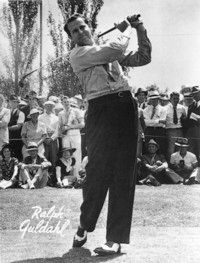
Ralph Guldahl was tall, Texan, and undeniably dominant for a stretch that feels almost impossible in modern golf. At 6’3″, he is one of only six players in history to win the U.S. Open in consecutive years. He won the crown in 1937 and 1938. He then won the Masters in 1939.
For a few years in the late 1930s, he was simply the best player in the business.
But then his game disappeared. For the second time.
It is one of the great mysteries of golf history. You look at the record books, see the wins, and wonder how such an accurate player could simply disappear from the major leagues. Most golfers fade. Guldahl fell off the cliff.
Early promise and initial collapse
Guldahl didn’t start out as a known entity. He came to prominence in 1932, winning the Arizona Open at just 20 years old. He arrived on the national scene with great promise.
In 1933, he almost won the US Open. He played well. Then he missed a four-foot putt on the 72nd hole. He finished one stroke behind Johnny Goodman.
This loss devastated him. He went into a slump. Frustrated, he quit the tour in 1935.
He didn’t just stop playing. He changed his grip. He spent several hours practicing. He fixed the mechanics that had failed.
He returned in 1936 to prove he could still play. And he did. That year he led the tour in average. He won the Western Open in 1936, 1937 and 1938, which was considered one of golf’s biggest events at the time.
The foundation was set. The dominance was coming.
Open record from 1937
Oakland Hills hosted the 1937 US Open. Guldahl faced Sam Snead, a force of nature on tour. Guldahl defeated Snead by two strokes to win his first major championship.
The back nine was where he proved he belonged. He eagled the 8th hole. He birdied the 9th. He needed a low score to secure the win.
“If I can’t play the back nine in 37 shots,” he said, “I’m a bum and I don’t deserve to win the Open.”
He shot a 36 on the back nine. He finished with a score of 69. With 281, he set a new 72-hole US Open record.
It wasn’t just a win. It was a statement. He could close. He could deliver when it mattered most.
Winning streak and Masters victory
The following year, Cherry Hills hosted the Open. Guldahl did it again. He finished with a score of 69. He won by six shots.
Back-to-back U.S. Opens. A rare feat.
Then came the Masters in 1939. Guldahl beat Snead by one shot. Another final-round 69.