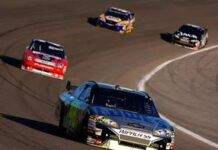
Building NASCAR stock car bodies is not a factory job. This is a painstaking process that requires precision and time and is done by hand. Allow 10 business days for the shop floor crew to build and install the vehicle themselves. There is no assembly line here. There are no robots that cut identical panels.
The shape of the car was not what its creator had imagined. NASCAR dictates every curve. These rules are enforced through a strict system of 30 physical models. Each corresponds to a specific profile on the chassis. If your car doesn’t match the model, you can’t compete.
Tolerance game: red line, blue line, green line
You might think of a model as just rigid mold. it is not. A measuring device that detects small changes. NASCAR measures the gap between the model and the surface of the car. This difference cannot exceed a certain tolerance.
These rules use a color coding system to define these boundaries. Pay attention to the edges of the model. The color indicates the number of play allowed.
- Red Line is the most serious. The gap between the mold and the body must be less than 0.07 inch (0.18 cm).
- Blue line offers more space. Gaps should be kept under 0.25 inch (0.64 cm).
- Green Line is the most forgiving. Maximum gap 0.5 inch (1.27 cm).
This system ensures consistency across the field. This prevents teams from building aerodynamic shapes outside of the regulations. But it’s not perfect. Thirty models could not cover every square inch of the complex bodywork. There are gaps between the positions of the model. In the unmonitored areas, the team had a little more room to adjust the airflow and intensity design.
Hand rolled metal, not stamped steel
The NASCAR body looks like a streetcar. It is not created equal. Street cars are mass produced. The panels are punched at high speed from large molds. NASCAR bodies are made by hand.
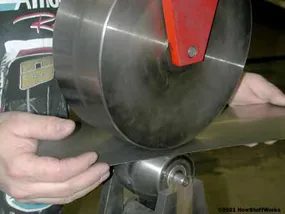
The only prefabricated panels are the roof, hood and trunk lid. These are supplied by Dodge. Everything else is raw materials. The team started with a flat sheet of metal. They are cut to the appropriate size. Then we use English wheel.
The tool is a pair of rollers. One is convex and the other is flat. The user inserts a metal plate into it. It processes the metal slowly by applying pressure and moving the plate in a specific pattern. The English wheel bend steel. This takes time. This takes skill. The goal is to match the defined outline to the model.
This process is labor intensive as it requires continuous inspection. Builders roll metal. They held the model. They measure the difference. If it is too tight, you will need to work more metal. If it is too loose, it is adjusted. It is a process of trial and error.
This method allows you to create special shapes that cannot be created with a compression mold. This also means that no two objects are exactly alike, even if they follow the same rules. The human element is incorporated into the machine.
Why is this important?
You might be wondering, why NASCAR?
Welding the puzzle together
Once the individual sheets of metal are hammered into their final, intricate curves, the real work begins. They are not bolted together. They are welded directly to the frame and to each other using custom templates to check every millimeter of alignment. It is a process that requires precision, not only in form but also in placement.
Smoothing the Surface
The seams between these pieces are welded shut and then ground down until there is no trace of where one panel ended and the other began. The goal is a surface that looks and feels like one unbroken sheet of metal. When the car is finished, it is a smooth, seamless piece. This is not just about aesthetics. It’s about reducing drag and ensuring structural integrity.
Doors that won’t open
The end result is so tight, so uniform, that you can’t even open the doors. Yes, that’s right. No handles. No hinges to worry about. The body is a monocoque shell, single entity from front to back. It’s a design choice that prioritizes rigidity and aerodynamics over convenience. You can’t get in and out; You are installed.
After the sheet metal is bolted and sanded in place, the body gets a fresh coat of primer and paint. Then come the decals. NASCAR cars don’t actually have headlights, but you can see them mounted on the front end. It’s a visual trick that brings the racing car closer to the showroom road-legal version. But behind the scenes, not only the appearance has changed.
Not all cars are built for the same track. There are two different types here: Short Track Cars and super-speedway cars. They may look the same at first glance, but the underlying design tells a different story.
The Roof and Spoiler Setup
For example, Take the roof. It’s not just a lid. This is a safety mechanism. When the driver loses control and the car starts spinning, the flaps in the rear wing deploy. These flaps disrupt the airflow and eliminate the aerodynamic lift that can cause the car to cartwheeling through the air. This is a simple solution to a terrifying problem. If you’re curious about the physics of keeping metal on the track, you can learn more about how NASCAR safety works.