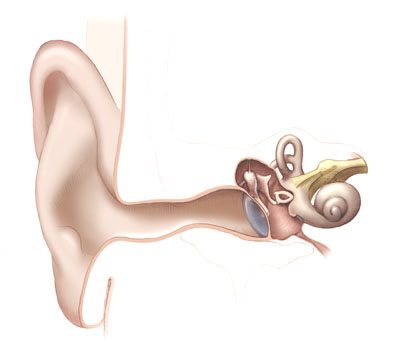
Your hearing is a mechanical marvel. While smell, taste and sight rely on chemical reactions to stimulate your senses, your ears work purely physically. They capture vibrations from the air and convert them into a language your brain can understand. It is a sensitive, highly accurate system that converts physical movement into perception.
To understand how this works, you first need to understand what sound actually is. Sound is a vibration that travels through matter. This substance can be solid, liquid or gaseous. Most of the time you can hear vibrations that travel through the atmosphere.
When an object vibrates in the air, it collides with nearby air particles. These particles collide with their neighbors. The pulse travels outward like a domino effect.
Consider a bell. Hit it and the metal will bend. When it bends outward, it compresses the air against itself. This causes the particles to push together. This area of high pressure is called compression.
As the metal bends inward again, it pulls away from the air. Pressure drops. Ambient air flows in and fills the gap. This creates a low pressure zone known as a rarefaction.
A vibrating object sends a wave of these pressure fluctuations through the air. Due to variations in the frequency of the wave, you perceive different sounds. At high frequency, the pressure changes rapidly back and forth. You will hear this with a high voice. Low frequency means slower switches. You will hear a deep tone. The intensity or amplitude of the pressure change determines the volume.
The ear must perform three tasks to enable hearing. It has to catch the waves. It must detect changes in pressure. Finally, it must convert these fluctuations into electrical signals for the brain.
Catching and Locating Sound
The pinna, i.e. the outer ear, acts as a funnel. It directs the sound waves to the hearing mechanisms inside. The shape of the ear is not random. It has curves and folds that interact with the incoming sound.
This geometry allows you to determine exactly where the sound is coming from. When sound hits your ear in front, it reflects off the surface in a certain way. Sound from behind or above is reflected differently. These reflections change the wave pattern before it enters the ear canal.
Your brain is programmed to detect these subtle changes. It uses the changed pattern to determine direction. Is there a sound ahead? Behind? Above? The brain decodes the physics of the reflection to create a spatial map.
Sound localization is a quick calculation. Your brain compares the input from both ears to determine where the sound is coming from. The sound on the left will hit your left ear first. It’s also louder there.
The pinnae are directed forward, so people can hear better from the front. Dogs use large, movable pinnae to determine direction. Human ears are flatter. We don’t have the muscles to turn them. We can mimic this by putting our hands behind our ears. This creates a larger surface area to intercept the sound waves.
But the real work begins in the ear canal.
tympanic membrane mechanics
Sound waves pass through the ear canal and hit the eardrum. This is the eardrum. It is a thin, cone-shaped membrane. About 10 millimeters wide. It sits between the ear canal and the middle ear.
The middle ear is connected to the throat through the Eustachian tube. Air comes in through the outer ear and mouth. This keeps the pressure on both sides of the eardrum the same. Even pressure allows free movement.
The membrane is rigid. It is also very sensitive. Small changes in air pressure make it move. The tensor tympani muscle pulls it inward. This tension keeps the membrane taut. It ensures that vibration occurs no matter where the sound wave hits.
the tension of the tympanic membrane is crucial. Without it, the sound transmission becomes ineffective.
This setting prepares the ear for the next level. The vibration must be transmitted to the inner ear. Let’s look at what happens when the wave interacts with the eardrum and travels deeper.
那层薄膜承担着繁重的任务。 它的工作原理类似于麦克风的隔膜。 声波通过压缩和稀疏来推动它来回移动。 高音调的声音使其振动得更快。 更大的噪音迫使它移动更远的距离。
但耳膜不仅仅是一个接收器。 它是一个保护者。
当你面对长时间、大声、低音的噪音时,你的大脑会触发反射。 鼓膜张肌和镫骨肌 突然收缩。 这会向相反的方向拉动鼓膜和附着的骨头。 膜收紧。 它变得僵硬。
为什么这很重要?
反射可抑制低频噪音,让您在混乱的环境中专注于高音调的声音。
该机制有两个不同的目的。 首先,它可以保护内耳免受损伤。 其次,它可以帮助你集中注意力。 通过掩盖响亮的背景隆隆声,它可以隔离您需要听到的频率。 想象一下在摇滚音乐会上讲话。 甚至只是正常说话。 当你开始说话时,反射就会开始。 没有它,你自己的声音就会淹没房间里的其他一切。
耳膜收集所有的感觉数据。 耳朵的其余部分只是传输它。
放大机制
The variations in air pressure caused by sound are small. The force applied to the membrane is almost non-existent. However, because the membrane is highly sensitive, even a small force causes it to move a considerable distance.
Here’s the problem. The sound must reach the 耳蜗. The inner ear, however, is not filled with air, but with fluid.
Liquid has greater **惯性 than air. Try pressing a balloon and then a bucket full of water. Water wins. The resistance is greater. A small force from the eardrum is not strong enough to move the fluid filled with the membrane directly. If the sound went straight, the silent sounds would be almost inaudible.
Before the signal reaches the inner ear, it is necessary to 放大总压力
这是听小骨的任务 These are small bones located in the * * middle ear**. In reality, they are the smallest bones in the body. They form a chain that transmits energy from the eardrum to the 充满液体的耳蜗
The chain consists of three special bones:
-
Malleus (hammer)
-
Incus (anvil)
-
**镫骨 (stirrup)
Sound doesn’t just travel; it transforms. When the acoustic waves hit your ear, they don’t stop at your skin. They cause the eardrum to vibrate. This vibration sets off a mechanical chain reaction involving three small bones: the hammer, the anvil, and the stirrup.
The malleus sits on the inside exactly in the middle of the eardrum. It works like a lever. When the eardrum vibrates, the hammer swings back and forth. Its other end is connected to the anvil. The anvil, on the other hand, is attached to the stapes. The stapes is the last piece. Its front panel rests on top of an oval window that leads directly into the cochlea.
This setting handles both compression and rarefaction. When air pressure presses on the eardrum, the ossicles move to force the stapes faceplate into the cochlear fluid. When the pressure is released, the bones move in the opposite direction, drawing the fluid back. The stirrup essentially functions as a piston. It creates waves in the fluid of the inner ear that reflect the air pressure fluctuations of the original sound.
The physics of amplification
There is a problem with the ear. Air transfers sound poorly to liquid. The inner ear is full of fluid. Without ossicles, most of the sound energy would be reflected from the surface of the liquid. These bones reinforce the strength of the eardrum in two different ways.
First, there is a simple difference in surface area. the eardrum is large, about 55 square millimeters. The front plate of the stirrup is small, about 3.2 square millimeters. Sound waves apply force to the entire eardrum. This energy is transferred to the much smaller stapes. Concentrating this energy into a smaller space increases the pressure significantly. This is hydraulic multiplication. Think of it like a hydraulic press where a small input force becomes a huge output force due to the area ratio.
Second, the structure of the bone itself provides leverage. The hammer is longer than the anvil. This creates a basic leverage system. The hammer moves further. The anvil moves with more force. Energy equals force times distance, so the trade-off favors force yield.
The result is remarkable. The pressure on the cochlear fluid is about 22 times greater than the pressure on the eardrum. This amplification is critical. It ensures that sound information actually crosses the threshold into the inner ear, where it can be converted into nerve impulses that can be decoded by the brain.
Cochlear decoding
When the signal passes the stapes, it goes to the inner ear. This is the most complex part of the auditory system. Its task is simple, but mechanically difficult: take physical vibrations and convert them into electrical data. The brain recognizes this information as different sounds.
The cochlea looks like a snail shell. Inside there are three tubes side by side, separated from each other by sensitive membranes. These pipes are twisted, but it helps to imagine them stretched out to understand the flow. The three pipes are Scala Vestibuli, Scala Media and Scala Tympani.
The scala vestibuli and scala media are separated by a membrane so thin that sound waves pass through them as if they were one chamber. This unit allows the pressure wave from the stapes to effectively move fluid through the top of the shell. The wave travels along this path and sets the stage for the actual transduction process that takes place deeper. The flowing motion here is the precursor to the neural firing that defines hearing.
The system is based on accuracy. If the bones were stiff, the sound would be muffled. If the eardrum were too loose, energy would be lost. Anatomy tuned for efficiency. 22 times amplification compensates for the impedance mismatch between air and liquid. Without it, we would hear a fraction of the world around us. The inner ear then absorbs this increased mechanical energy and begins electrical conversion. The spiral shape is not only aesthetic; It allows for a longer basilar membrane in a small space, allowing for frequency discrimination. But this difference happens next. At the moment, the liquid is just moving.
From mechanical waves to neural signals
When the stapes piston moves the fluid in the cochlea, it sets off a wave of vibrations that travels down across the basilar membrane. It’s not just a simple push and pull. The stapes create pressure waves that spread throughout the cochlea chamber. Since the liquid is not easily compressed, it has to be transported somewhere. This is where the round window membrane comes into play. It acts as a pressure relief valve by moving outwards when the stapes pushes in and sinks back when the stapes retracts. This dance keeps the fluid moving without damaging the delicate internal structures.
The center of this mechanical translation is the basilar membrane. It is a rigid structure that runs the entire length of the cochlea. When the stapes moves, it moves the membrane directly under the oval window. A wave is formed. It looks like waves spreading across the pond and moving from the entrance to the other end of the spiral.
But the membrane is not uniform. It consists of 20,000 to 30,000 small reed-like fibers. These fibers physically change as they move along the cochlea. Near the oval window, they are short and stiff. Further down, towards the closed end of the tube, they become longer and more flexible.
This gradient creates different resonant frequencies across the membrane. Think of it like piano strings, only a thousand times more complicated. A certain frequency of sound perfectly resonates with the fibers in a certain place and causes them to vibrate strongly. It’s the same physics that makes a tuning fork sound when you hit it, or a kazoo hums when you hum.
For most of its journey, the wave does not release much energy. The membrane is too tight. However, when the wave hits fibers that have just been tuned to that frequency, energy is suddenly released. The higher tones initially hit the stiff, short fibers. Lower-pitched sounds spread down to looser, longer fibers.
Hair cells and Neural Processing
So how does the brain know which pitch it’s hearing? Location is important. Higher pitches activate the area near the oval window. Lower pitches activate the area near the end of the cochlea. But a mechanical wave consists only of data. It has to become a signal that the brain can read.
This is the job of the organ of corti. It sits directly on top of the basilar membrane and extends the entire length of the cochlea. There are thousands of hair cells in this structure.
Before the wave reaches its resonance point, the basilar membrane barely moves. When it reaches this optimal point, the membrane jerks upward with a burst of energy. This movement bends the hair cells of the organ of Corti.
Bending these hairs triggers an electrical impulse. The impulse travels via the cochlear nerve directly to the cerebral cortex. The brain doesn’t just hear “sound”. It determines the signal based on its location. If the impulses come from the base of the membrane, the brain registers a high tone. When they come from the end, it’s a low note.
Volume works differently. A louder sound releases more energy at this resonance point. This causes more hair cells to bend. The more cells that fire, the stronger the signal. The brain interprets this increased activity as volume.
The clamcochlea itself is just a raw data processor. It spits out complex patterns of electrical impulses. The brain works like a supercomputer, picking up this sound and creating a coherent listening experience. It’s an incredibly complex operation. Researchers are still trying to get a full picture of how this works.
Hearing remains one of the great mysteries of biology. The basic mechanisms of human and animal ears are simple, but the specific cellular structures are bewilderingly complex. We’re making fast progress. New hearing elements are discovered every year. It’s overwhelming to think how much processing goes on in such a small hiding place in your head.
Frequently asked questions about the hearing function
How does sound travel in the ear?
The sound penetrates the ear canal and hits the eardrum. the eardrum vibrates and moves the malleus bone. This movement is transmitted to the anvil and then to the stapes. The stapes push into the cochlea and create fluid pressure waves. These waves stimulate nerve endings, which convert the vibrations into electrical impulses. The brain receives and interprets these signals.
Which part of the brain processes sounds?
The auditory cortex located in the temporal lobe processes auditory input. It is part of a larger system responsible for both basic hearing functions and complex sound recognition.
What parts does the ear consist of?
The ear consists of the outer ear (auricle and ear canal), the middle ear (tympanic membrane and ossicles) and the cochlea (vestibule, cochlea and auditory nerve). The Eustachian tube also plays a role in pressure regulation.
What is the difference between sound and hearing?
Sound is a physical phenomenon. These are vibrations that are transmitted through air or other mediums. Hearing is a biological sense. It is the process by which the organism perceives, recognizes and recognizes these vibrations.
What is the function of hearing?
Hearing is a mechanical and neurological process. With it, the brain recognizes and understands the surrounding sounds. The cochlea structures responsible for hearing are also related to balance.
The Anatomy of Sound and Silence
The journey through acoustics doesn’t end with how ears process waves. It spills over into the mechanics of the devices that create, capture, and tame them. Understanding the physics behind a guitar string or a muffler changes how you listen to the world. It turns noise into data.
From Strings to Silencers
You can trace the lineage of sound from the vibration of a wooden guitar body to the complex engineering of a car muffler. Both manipulate pressure waves. One amplifies them for art. The other dissipates them for peace.
Microphones perform the reverse operation. They convert physical movement into electrical signals. There are dozens of types, each tuned for specific frequencies or environments. A dynamic mic handles rock concerts. A condenser mic captures the breath in a vocal booth. The choice dictates what you hear.
Decibels and Danger
Then there is the question of volume. How loud is too loud? The decibel scale is logarithmic, not linear. An increase of 10 dB represents a tenfold increase in intensity. But to the human ear, it sounds only about twice as loud.
Listening to sounds above 85 dB for extended periods can cause permanent damage. The threshold of pain sits much higher, around 130 to 140 dB. But you don’t need to reach the pain threshold to lose your hearing. Cumulative exposure matters more than a single loud moment.
The Myth of the Seashell
Why does a seashell sound like the ocean? It doesn’t. The shell amplifies ambient noise in the room. Your own blood rushing through veins adds to the low-frequency roar. It’s a trick of acoustics, not a recording of the tide.
White noise works similarly. It fills the silent spaces with a steady hum. This masks sudden, jarring sounds. That’s why many people sleep better with a fan running or a white noise machine. It creates a consistent auditory blanket.
The Physics of Boom and Whisper
A sonic boom occurs when an object moves faster than the speed of sound. The pressure waves pile up into a single shock front. It’s a loud, abrupt release of energy.
Conversely, a tin-can telephone proves that sound travels through solids. The string acts as a conduit. Vibrations move directly from one cup to the other, bypassing the air. It’s a simple, effective demonstration of how mediums change the transmission of sound.
Deeper Dives
For those who want to go further, the resources are vast. The Cochlear Fluids Lab offers a technical look at the inner ear’s mechanics. NoiseNet provides data on environmental sound levels. The UK Quiet Pages advocate for spaces free from artificial noise.
An anatomical tour of the ear reveals the intricate bone structure that protects the delicate hair cells inside. Seeing, hearing, and smelling the world are interconnected senses. They rely on the brain’s ability to interpret chaotic signals into coherent experience.
The silence isn’t empty. It’s waiting for a sound to fill it.