Most road cars use standard suspension setups. Formula One cars use double wishbone systems. Springs, dampers, arms, and anti-sway bars handle the load. Teams tweak these settings before every race. They want safety in braking. They want precision in cornering. They want responsive handling. It is a delicate calibration. Get it wrong, and the car is undriveable. Get it right, and you have a competitive machine.
The Physics of Stopping Power
Road car brakes look familiar. Discs. Pads. Calipers. But F1 brakes operate in a different universe. The car hits speeds over 200 mph. Stopping that mass requires immense force. The brakes glow red-hot when used. That is not an exaggeration. It is physics.
Carbon fiber discs and pads solve the problem. They are lightweight. They handle extreme heat. They work effectively up to 750° C (1,382° F). Holes around the disc’s edge let heat escape. Air intakes sit outside the wheel hub. They force air onto the brakes. Teams change these intakes for each track. Why? Because braking requirements vary wildly from Monaco to Monza.
Tires: The Only Contact Point
Tires might be the most critical component in an F1 car. Think about it. The engine, suspension, and brakes all transmit force through the tires. They are the only parts touching the asphalt. If the tires fail, the car fails. No amount of aerodynamic superiority saves a bad tire choice.
Slick tires ruled the sport from the 1960s to 1998. No tread. High contact area. They offered maximum grip. The FIA changed the rules. They wanted lower cornering speeds. They wanted closer racing. Tread patterns were reintroduced.
Current regulations are strict. Front tires must be 12 to 15 inches wide. Rear tires must be 14 to 15 inches wide. Four longitudinal grooves run around the circumference. Each groove is at least 2.5 millimeters deep. They sit 50 mm apart. This is for wet conditions. Intermediate and wet tires feature full tread patterns. They channel water away from the road surface.
The rubber compounds are incredibly soft. Heat makes them stick to the track. This provides enormous gripping power. Racing tires perform best at high temperatures. Drivers warm them up before the race starts. The trade-off is durability. A single F1 tire lasts about 125 miles. That is it. Wear and tear is constant.
Traction Control: A Banned Advantage
Traction control can extend tire life. It limits wheel spin. This is crucial under the load of cornering. Electronic sensors compare wheel speed to road speed. If the wheel spins faster than the road, the system detects a loss of traction. The engine throttle is automatically reduced. The car stays stable.
The history of traction control in F1 is erratic. It has been allowed. It has been banned. It returned in the 2002 season. Then it was outlawed again at the start of the 2008 season. Drivers must manage power delivery by hand now. It adds another layer of difficulty. It also changes how tires wear. Without electronic aid, tire management becomes a primary skill.
The interplay between suspension geometry and tire wear defines race strategy. Teams spend millions optimizing this relationship. The data is immense. The margins are tiny. One degree of camber change can alter lap times by tenths of a second. This is where championships are won. Not just in the engine bay. But in the way the car sits on the road.
And yet, despite all the technology, the driver still makes the final call. The tires scream. The brakes bite. The suspension compresses. And the car moves forward. It is a chaotic balance of forces. Unpredictable. Dangerous. Beautiful.
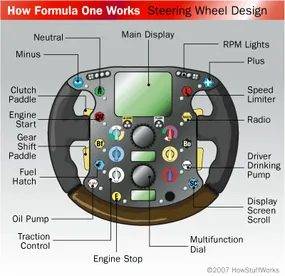
The Command Center
Forget everything you know about road car interiors. The F1 steering wheel is less a control interface and more a compact cockpit computer. It is tiny. About half the diameter of a standard wheel. Yet it packs a dizzying array of buttons, toggles, and switches.
This is the command center.
With a single finger, a driver manipulates nearly every aspect of performance mid-lap. Gear shifts? Sorted. Brake balance? Adjusted. Fuel mixture? Managed. It is precise. It is rapid. It is necessary.
Safety rules dictate that a driver must escape the cockpit in under five seconds. To make this possible, nothing is permanently fixed except the wheel itself. It attaches to the column via a snap-on connector. Pop it off. Out you go.
But the wheel only works because of the machinery behind it. Formula One is not a solo sport. It is a massive team effort. Over 100 people on each squad work tirelessly to turn that season of success. We will look at who they are next.