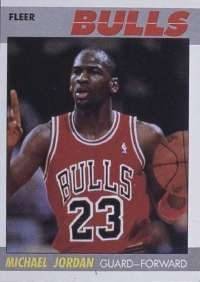
Michael Jordan is often cited as the greatest basketball player to ever touch a court. His career scoring average sits at the top of the NBA history books. He claimed one college title, two Olympic golds, and six NBA championships. Ten scoring titles? That’s a record that still stands. He had an offensive arsenal deeper than anyone else’s.
He was also the most recognizable athlete on the planet. Endorsement checks for Jordan dwarfed those of his peers. McDonald’s created the McJordan burger. North Carolina paved seven miles of Interstate 40 in his honor. He hosted Saturday Night Live. He was everywhere.
His game was defined by gravity-defying dunks and that exaggerated hang-time. But don’t mistake him for a one-note athlete. For a guard, he was a nightmare on the boards and in the paint. Three times he led the league in steals. Nine times he made the All-Defensive First Team. He was, quite simply, a complete player.
Born in Brooklyn in 1963, Jordan grew up in Wilmington, North Carolina. His dad worked for GE. His mom worked at a bank. Sports came naturally. Baseball was actually his first love. He won MVP as a kid in the Babe Ruth League when they took the state title.
Basketball was a different story. He failed to make the varsity team at Laney High School as a sophomore. That snub lit a fire. He worked harder. He made the starting lineup as a junior. He earned a scholarship to UNC.
As a freshman, he averaged 13.5 points. He hit the game-winner against Georgetown in the NCAA title game. He played two more seasons at North Carolina, hitting 39 points in a single game at his peak. In 1984, he took home both the Naismith and Wooden Awards as national Player of the Year.
He left college early for the draft. Houston picked Hakeem Olajuwon. Portland took Sam Bowie. Chicago landed Michael.
The Bulls were a mess back then. A roster full of has-beens and never-weres. They became “Michael and the Jordanaires.” Jordan averaged 28.2 points as a rookie. He won Rookie of the Year. But then his foot broke. He missed 64 games in his second season.
He returned for the playoffs. Boston swept the series, but Jordan put on a show. He scored 49 points in Game 1. Then he dropped 63 in Game 2. A playoff record at the time. It wasn’t enough. The Celtics took the series.
By the 1986-87 season, Jordan was averaging 37.1 points. He was the first player in 24 years to break the 3,000-point mark for a season. He joined Wilt Chamberlain as one of the few to score 50+ in three straight games.
The next year, he won his first MVP. He also became the first player to win the scoring title and Defensive Player of the Year in the same season. That’s insane efficiency.
Detroit hated him. The Pistons built 13 different defensive sets just to stop him. They called it “The Jordan Rules.” They beat him in the playoffs in ’88, ’89, and ’90. They contained him every time. He still won the scoring title in ’89 and ’90. He even played point guard for a stretch in spring 1989, getting triple-doubles in seven consecutive games.
He had a special hatred for Cleveland. In the 1988 playoffs, he averaged 45.2 points against them in a five-game series. Record territory. He hit a buzzer-beater to eliminate them in 1989. On March 20, 1990, he scored 69 points in Cleveland.
The Bulls finally got the roster right in the early 90s. They added Scottie Pippen and Horace Grant. Jordan called them his “supporting cast.” It worked. They beat the Lakers in ’91. Portland in ’92. Phoenix in ’93. That first three-peat since the 60s Celtics.
Against the Lakers, he averaged 31.2 points, 11.4 assists, 6.6 rebounds, and 2.8 steals. Against Portland, he had 35 points and six threes in the first half of Game 1. Against Phoenix, he averaged 41.0 points in the Finals. The highest mark in NBA history.
He was at his peak. And then he quit.
On October 6, 1993, he announced his retirement. He cited a lack of motivation. His father had been murdered earlier that summer. It was a tragic time.
But he was already preparing for life off the court. He went to spring training with the Chicago White Sox in 1994. He played Double-A baseball in Birmingham, Alabama. He batted .202. Three home runs. 30 stolen bases. It wasn’t going well.
A players’ strike in 1995 forced him across picket lines to keep playing. He didn’t like it. He walked away from baseball.
On March 18, 1995, he sent a two-word message: “I’m back.”
He returned to the Bulls. Ten days later, he scored 55 points at Madison Square Garden. But he wasn’t sharp. He made mistakes. The Bulls got swept by Orlando in the Eastern Conference semifinals.
The 72-Win Miracle and a Record-Breaking Run
Jordan promised better things for the 1995-1996 season, and he delivered in spades.
He won his record eighth scoring title, averaging 30.4 points per game. He led the Bulls to a league-record 72 wins. And he swept the hardware, taking home MVP honors for the regular season, the All-Star Game, and the NBA Finals.
Two more titles followed in 1996-1997 and 1997-1998.
Then he retired for a second time.
The Wizards Experiment
Here is where it gets weird.
Jordan, at age 38, attempted a third comeback. He joined the Washington Wizards. Not just as a player, but on and off the floor, serving as an executive too. It was the 2001-2002 season.
Many derided the move. They called it a cash grab. A vanity project.
It wasn’t.
He was productive. He averaged more than 20 points per game across two seasons. He retired for the final time at age 40.
His 31.5 PPG career scoring average still tops history.
Behind the Scenes Failures
Jordan remains close to the NBA.
His Washington experience ended in failure. Wizards owner Abe Pollin essentially fired Jordan as general manager. The power dynamic was clear.
He made a failed run at purchasing the Milwaukee Bucks soon thereafter.
Now? He is a minority owner and general manager of the Charlotte Bobcats.
The Airness. The businessman. The player who refused to let the game go.
Does it end there?
The numbers say yes. The history books say it’s done.
But the basketball world never really forgets the guy who promised better things and then kept giving them. Until he didn’t.
Until he did.
Again.
The 63-Point Outburst That Changed Everything
You can argue about stats all day, but this was an event. It was Game 2 of the 1986 Eastern Conference Semi-Finals. The Boston Celtics were the league’s best team. The Chicago Bulls were still figuring themselves out. Michael Jordan was hurt. Most of the season he was on the sideline with a broken foot, but here he was, lacing up against the defending champions.
He didn’t just play. He exploded.
Jordan scored 63 points. At the time, it was an NBA playoff record. It still stands as the second-highest single-game playoff total ever. The Bulls lost. 135-131. Double overtime. The final score doesn’t matter as much as the performance. Jordan was untouchable.
The highlights from that night are legendary. He hit off-balance layups that looked impossible. He took on three, sometimes four defenders at once. The sequence that sums it up involves Larry Bird, Dennis Johnson, Kevin McHale, and Robert Parish. Jordan dribbled between his legs. He stepped around Bird. Johnson got in his face. He launched over McHale. Parish was flailing for help. Jordan double-pumped the ball in. One against four. He won the possession.
Bird, usually tight-lipped, didn’t hold back after the game. “No question he had control of the game,” Bird said. It wasn’t close. The Celtics had the score, but Jordan had the narrative.
This moment shifted how people viewed potential in a young guard. It wasn’t just about scoring. It was about taking the best team in the league and forcing them into overtime with a broken foot. The Bulls went on to lose the series, but the Bulls’ young star had arrived.
Why This Game Still Matters Today
When we look back at the greatest basketball players of all time, conversations often start here. This wasn’t a fluke. It was a statement.
Michael Jordan’s 63-point game remains the benchmark for playoff heroics. It showed that even when injured, his ceiling was higher than anyone else’s floor. The Celtics were a machine. They won 67 games that year. They beat Jordan’s Bulls in five games. But that one night? Jordan owned the court.
Comparing Playoff Greatness
People often compare this to other legendary performances. LeBron James has 51. Kobe Bryant had 50. Wilt Chamberlain had 60 in the regular season, but not in the playoffs until Jordan beat his mark. Why does this specific game resonate? Because of the context.
- Opponent Quality: The Celtics were the top seed.
- Physical Toll: Jordan was playing through injury.
- Volume: 63 points in double overtime is exhausting.
The stats are easy to find. The feeling is harder to replicate. Watching Jordan glide over McHale while Parish reached for the sky… you don’t forget that.
It wasn’t a championship. It wasn’t a title. But for anyone following the game, it was proof. The future was here. And it wore number 23.
The Bulls didn’t win the series. They didn’t even make the finals. But the rest of the league had to adjust. Suddenly, everyone had to